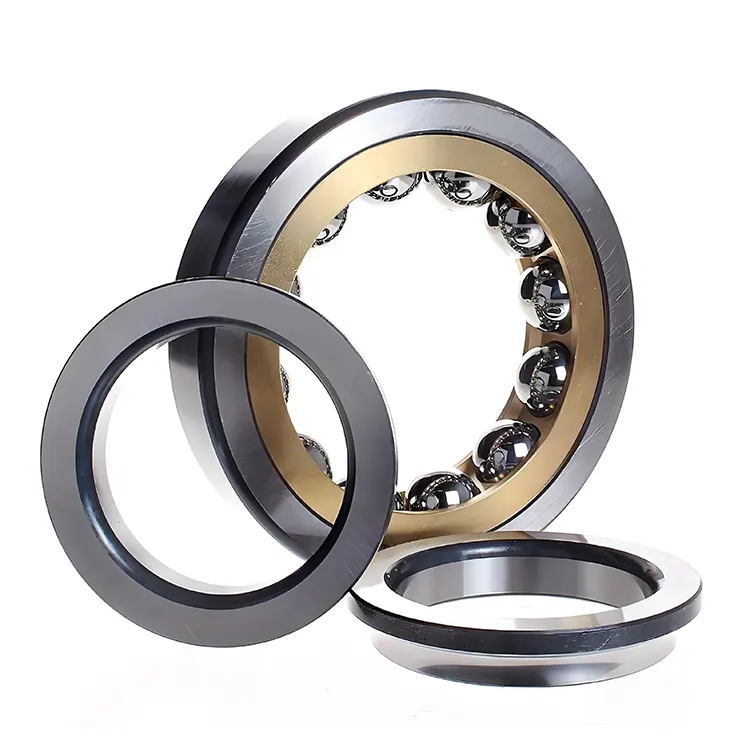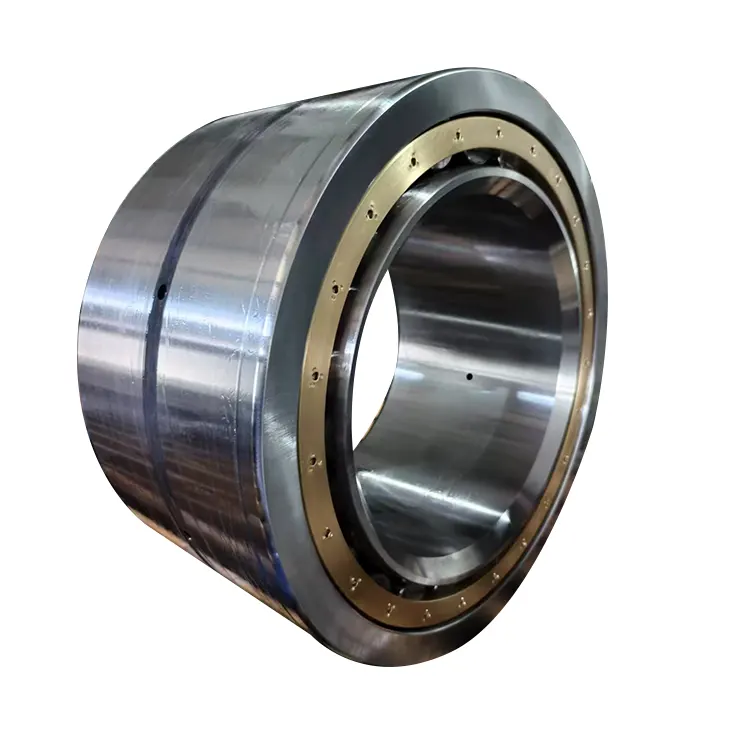

Take the bearing apart and the feature that matters is the groove. It is not a half circle. It is a shallow arch, ground so that a ball of the right diameter can sit against it at two separate spots, one either side of the lowest point. KOMEL produces this ring in Hefei on CNC grinders, and the whole character of the part follows from that one profile: the load path, the width, the torque, and the reason it can be sold as a drop-in replacement for a bearing pair twice its width. The same supplier grinds the Thin Cross Section Bearing with Four Point Ball Contact in seven series up to a 40.000 in bore.
A deep groove bearing uses a groove radius only slightly larger than the ball, which gives one contact area that can carry load in any radial direction. An arch groove is different. Its radius is larger relative to the ball, and the two flanks meet the ball at an angle rather than at the bottom. Ground correctly, the ball sits clear of the groove floor and touches only the two flanks.
That geometry is what gives the Thin Cross Section Bearing with Four Point Ball Contact its second load direction. A bottom-only contact cannot take thrust; a two-flank contact can, and it can do so on both sides of the ring at once.
During rotation the ball rolls on one flank pair under radial load and shifts to the other pair when thrust reverses. The shift is small, a matter of microns, and it happens without a change in the outer dimensions.
Because four points share the work, each individual contact carries less than it would in a single-point design of the same ball size. That is the trade: the ring gains load directions, and it loses a little of the pure radial capacity a deep groove ring of the same section would have.
Retainer design follows the same logic. A molded or machined cage keeps the balls spaced so that no two can touch, and it has to clear the arch on both sides, which is why the cages for this ring are not interchangeable with cages for a deep groove bearing of the same bore.
On a Thin Cross Section Bearing with Four Point Ball Contact the section is the distance across the ring wall, and it is small against the bore. In the catalogue the wall between bore and outside diameter is usually less than 10% of the bearing diameter, which is what makes a 12.000 in bore ring weigh 0.56 lb rather than several pounds.
A thin section changes how the ring behaves under load. Deflection is larger than in a heavy section ring of the same bore, so the housing shoulder and the shaft shoulder both have to be square and clean, and clamping force has to be spread rather than concentrated at one point.
The smallest series, KAA, starts at a 1.000 in bore and a 0.026 lb weight; the largest rings in the range reach a 40.000 in bore. The table gives the three smallest KAA sizes plus the first two KA sizes, all in inches.
| Number | Bore (in) | OD (in) | L1 (in) | L2 (in) | Weight (lb) |
| KAA10XL0 | 1.000 | 1.375 | 1.140 | 1.235 | 0.026 |
| KAA15XL0 | 1.500 | 1.875 | 1.640 | 1.735 | 0.039 |
| KAA17XL0 | 1.750 | 2.125 | 1.890 | 1.985 | 0.045 |
| KA020XP0 | 2.000 | 2.500 | 2.186 | 2.314 | 0.10 |
| KA025XP0 | 2.500 | 3.000 | 2.686 | 2.814 | 0.13 |
The three KAA sizes share a 0.375 in section and the two KA sizes 0.500 in. That is the property a Thin Cross Section Bearing with Four Point Ball Contact is chosen for: the bore can grow without the wall growing with it.
The arch groove is the whole advantage. Two contact points on the inner ring and two on the outer give the ball a diagonal load path, so a reversing force changes contact pair without adding a second bearing. A deep groove ring of the same bore takes radial load well and some thrust, but it has one load path and no symmetrical flank pair to cross to.
Because the section stays small against the diameter, the ring fits where a conventional angular contact pair needs a second seat. The wall is usually under 10% of the bearing diameter, and the series run from KAA to KG in inch dimensions. The contact is rolling, so drag stays low with the shaft horizontal or vertical.
The trade is plain: four points give versatility, not double the rating. If one direction dominates and very high axial stiffness is the design driver, a matched pair is still the correct calculation.
1. Grinding capability: the Hefei base runs high precision CNC grinders and lathes, plus heat treatment and testing equipment. An arch groove is a ground feature, so the equipment list matters more here than on a standard deep groove ring.
2. Custom work: the company states it offers customised bearing solutions for special needs, which covers a bore or a groove requirement outside the stock tables.
3. One line: all seven series, KAA through KG, are produced in the same base, so stepping up a section does not mean finding a second supplier or redrawing the interface.
More than ten years of bearing production is long enough to have met most of the fitting mistakes that show up on a four point ring, and the pre-sale technical team is the group that reviews them before a size is fixed.
A: Because there are two rings. Each ring has one arch groove, and each arch contacts the ball on two flanks, so the pair of rings gives four contacts in total. Under a given load only part of them are active at once.
A: Not at moderate speed, because the ball still rolls. Heat comes from over-filling with grease and from excessive preload rather than from the contact count itself. Keep the grease charge low and the clearance as specified.
A: Yes. With the axis vertical the axial load becomes the dominant one and the upper contact pair does most of the work; the ring does not need a different part number for the orientation.
A: The load case. Pure radial load with generous width is better served by the simpler groove. Once thrust appears in either direction, or the housing width is fixed, the four point design earns its place.
A: Where stiffness matters more than width, two rings can be mounted face to face with a shim. That is a housing decision rather than a catalogue item, and it should be discussed with the technical team before the bore is fixed.
A Thin Cross Section Bearing with Four Point Ball Contact is an arch groove ground on both rings, touching the ball at four points in total. Thin wall, low weight, thrust in both directions, and one part number where two used to sit.
Drawings and load cases can be sent to info@komelbearings.com; the reply will state the series, the number and the fits rather than a list of possibilities.