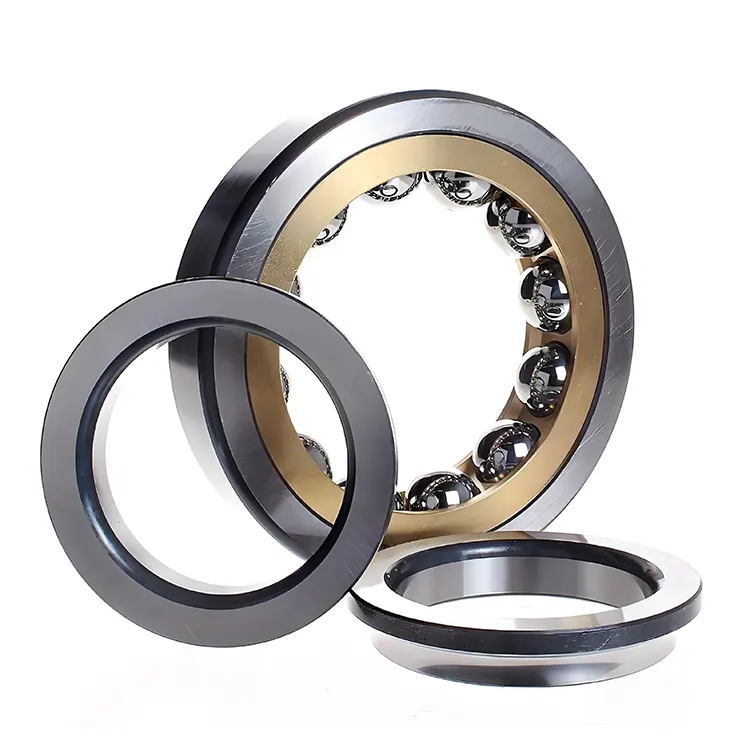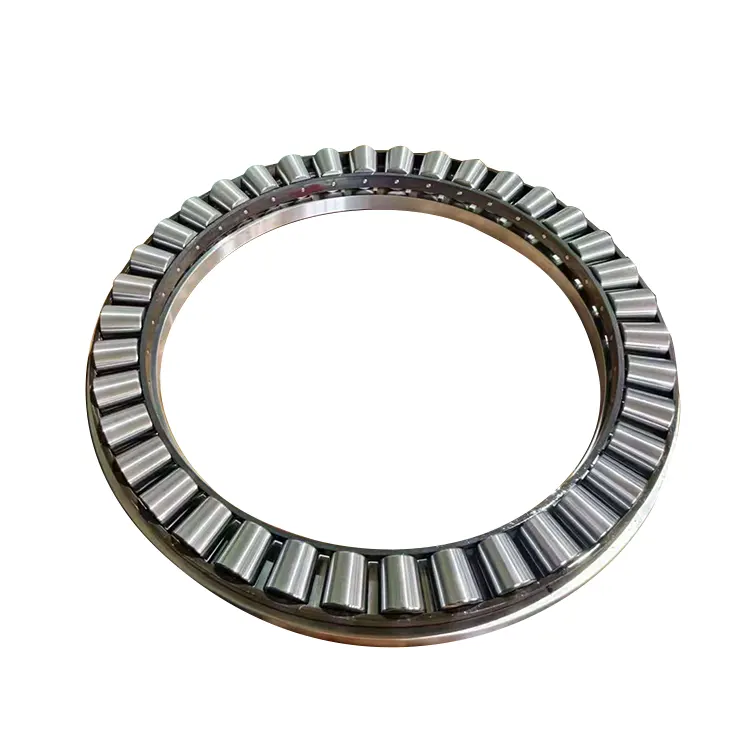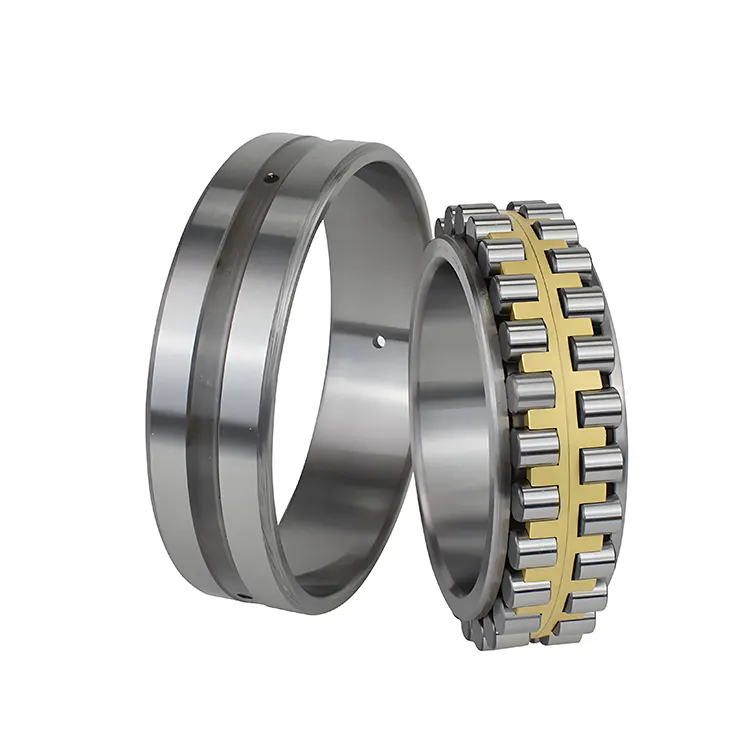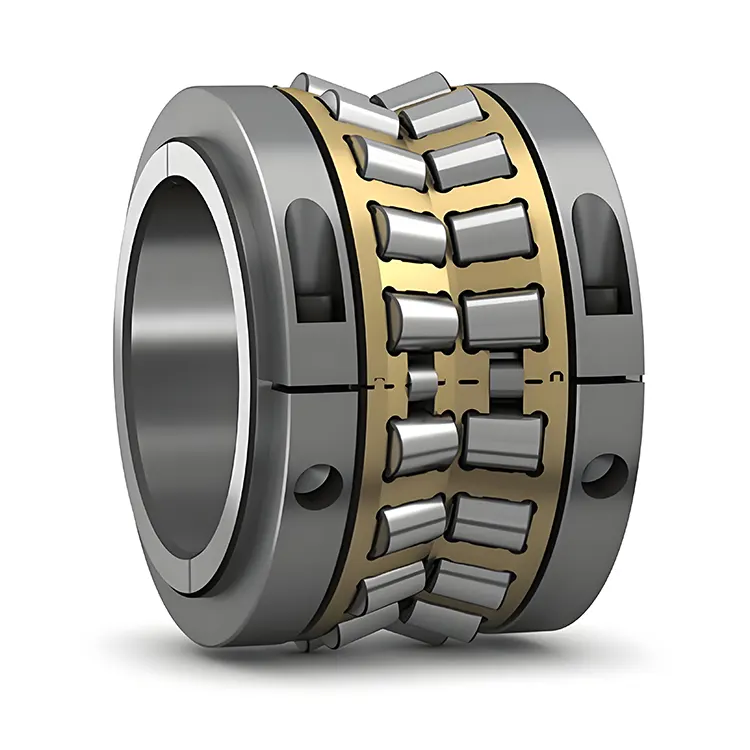

A reversing thrust is the case that breaks a single direction bearing. Something in the machine pushes the shaft one way under load and the other way on the return stroke, and a bearing that can only resist one of those needs a partner on the opposite side. KOMEL grinds this ring so the same groove resists both pushes, which removes the partner, its seat and the spacer between them. The notes below are about what that means at the point where the load changes sign. KOMEL is a manufacturer of the Thin Section Bearing for Bidirectional Axial Load Support in seven series, which is why the same groove shape appears from a 1.000 in bore upward.
Look at the groove in section and it is symmetrical. The arch rises to the same height on both sides of the lowest point, so a ball pressed left sits against one flank and a ball pressed right sits against the other. Nothing in the geometry favours one direction.
That symmetry is why a Thin Section Bearing for Bidirectional Axial Load Support can hold a shaft that is pushed in both directions during one cycle. The ring does not know which way the load will come; it only needs the ball to stay in contact with the correct flank, and the clearance set at manufacture decides how far the shaft can move before it does.
Two angular contact bearings arranged opposed do the same job as a Thin Section Bearing for Bidirectional Axial Load Support, with two rings and two seats. The four point ring does it with one. Under thrust to the left, the left hand contact pair loads; under thrust to the right, the right hand pair loads and the first pair goes quiet.
There is a consequence that is easy to miss. Because only two of the four points are working at any moment, the ring's capacity in one direction is that of the pair, not the sum. Sizing on the total of four contacts overstates what the bearing will carry.
On a Thin Section Bearing for Bidirectional Axial Load Support the axial clearance is the travel available before the ball crosses from one flank pair to the other. Too much and the shaft moves visibly on reversal; too little and the ring runs with a preload it was not built for.
Three settings are worth stating on the drawing:
1. Clearance class: the standard range leaves a small axial float that suits most positioning axes.
2. Reduced clearance: for a reversing axis where lost motion shows up as an error at the tool.
3. Preload: for stiffness, at the cost of torque and heat, and only where the duty allows it.
The table spans two sections at overlapping bores, which is how the choice is normally made: the bore is set by the shaft, the section by the thrust. Dimensions are inches, weight in pounds.
| Series | Number | Bore (in) | OD (in) | L1 (in) | L2 (in) | Weight (lb) |
| KA | KA030XP0 | 3.000 | 3.500 | 3.186 | 3.314 | 0.15 |
| KB | KB040XP0 | 4.000 | 4.625 | 4.231 | 4.393 | 0.30 |
| KA | KA060XP0 | 6.000 | 6.500 | 6.186 | 6.314 | 0.28 |
| KB | KB060XP0 | 6.000 | 6.625 | 6.231 | 6.393 | 0.44 |
| KB | KB090XP0 | 9.000 | 9.625 | 9.231 | 9.393 | 0.66 |
| KA | KA100XP0 | 10.000 | 10.500 | 10.186 | 10.314 | 0.50 |
At a 6.000 in bore the two options differ by 0.16 lb and 0.125 in of section. On a reversing axis with a long stroke the KB version is usually the safer pick, because the extra wall reduces the tilt that shows up as lost motion.
1. Both directions in one ring: the symmetrical arch groove takes a push from either side, so a reversing axis needs no opposed pair and no spacer.
2. Less axial space: the width is close to that of one angular contact bearing, which is the room a designer usually does not have.
3. Defined clearance: the travel before the ball crosses from one flank pair to the other is set at the factory, and the clearance class can be called out on the drawing.
What the design does not do is double the axial rating. A single ring is rated as one bearing, and where continuous heavy thrust runs in one direction a dedicated arrangement may be the safer calculation.
The Hefei plant has concentrated on the research, development and production of roller and ball bearings for more than ten years. Seven thin section series, from KAA to KG, are ground in the same base, covering bores of 1.000 to 40.000 in and weights of 0.026 to 30.80 lb. A buyer who needs the same groove behaviour at two very different diameters can stay with one supplier.
The company holds ISO9001 and ISO14001 certification, and its technical team gives selection advice and custom solutions before an order is placed. Products have been exported to markets across North America, Europe, South America, the Middle East and Southeast Asia.
A: The movement equals the axial clearance, which is set at manufacture. In the standard class it is small enough to be invisible on most axes; where it is not, the reduced clearance class should be ordered.
A: Yes, and in that case the ring is oversized for the duty. A single direction bearing would do the same work in a smaller section, so a four point ring is chosen there for availability rather than for need.
A: The ball rides up the flank and the contact becomes edge loaded, which shows first as noise and then as spalling on the shoulder of the groove. A step up in section is the answer, not a change of lubricant.
A: No. On a vertical shaft the thrust is constant rather than reversing, and the lower pair carries it. The ring is unaffected by orientation.
A: Reduced clearance is a normal order option. The figure should be stated on the drawing so that it can be ground and checked, since it cannot be adjusted after the ring is finished.
A Thin Section Bearing for Bidirectional Axial Load Support is a symmetrical groove that resists thrust from either side, in one ring where two bearings and a spacer used to sit. Capacity per direction equals one bearing of a pair, and the axial float is whatever clearance class was ordered.
Load direction, magnitude and the housing drawing can go to info@komelbearings.com; the reply will state the series, the clearance class and the fits.