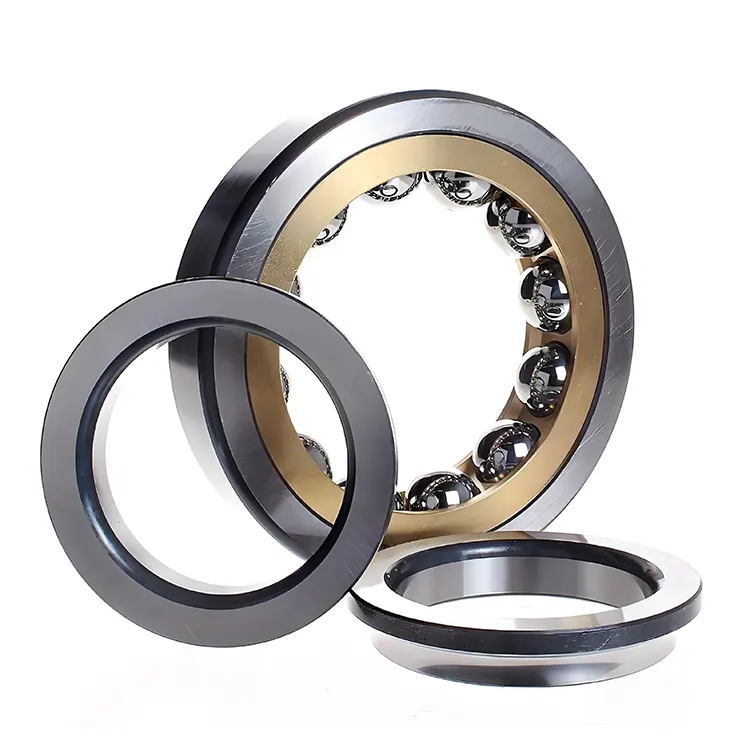

Robot joints punish a bearing in a way that a gearbox does not. The load direction changes with every pose, the arm hangs out further at full reach, and the mass behind the bearing has to be accelerated and stopped several times a second. KOMEL supplies this ring into that duty, from a plant in Hefei that has ground ball and roller bearings for more than ten years. What follows is written for the integrator who has to choose one ring per axis and justify the choice to a customer. The same factory supplies the Thin Section Rotary Bearing for Industrial Robot Joints in sizes small enough for a wrist and large enough for a waist.
A six axis arm gives three kinds of joint. The waist carries the whole arm and turns slowly with a large moment. The shoulder and elbow carry a varying moment as the arm extends. The wrist carries little load but has almost no space and must be light.
Different sizes of the same design cover all three, which keeps spares and assembly practice common across a machine. A Thin Section Rotary Bearing for Industrial Robot Joints at the waist is typically a large bore with a heavy section; at the wrist it is a small bore with the thinnest section available.
On a Thin Section Rotary Bearing for Industrial Robot Joints, mass at the wrist costs more than mass at the waist. Every kilogram at the end of the arm is accelerated by the shoulder joint as well, so the saving is multiplied by the number of joints between the motor and the tool. This is the reason a thin section ring appears at the wrist even when a heavier bearing would last longer.
Four points matter in this duty, and each is worth stating when a joint is specified:
1. Mass: the ring is the moving part, so its own weight enters the torque budget.
2. Stiffness: a compliant joint shows up as a positioning error under load and as chatter during a cut.
3. Moment capacity: the peak moment arrives at full reach, not at the rated payload near the base.
4. Lost motion: clearance that is invisible on a slow axis becomes a visible path error on a fast one.
A wrist joint usually has a hollow centre for cable and air routing, so a Thin Section Rotary Bearing for Industrial Robot Joints has to be a large bore ring with a thin wall around it. That combination is what a thin section bearing is for, and it is also why the wrist ring is often the largest bore in the arm rather than the smallest.
Clamping has to leave the hollow clear. The ring is normally held by its outer ring in the housing and by a shoulder on the shaft, with the motor and gearbox stack behind it, so the axial length of the joint stays short.
The small end of the range is where wrist and elbow joints are chosen from. The table covers the three KAA sizes and the first three KA sizes, in inches.
| Number | Bore (in) | OD (in) | L1 (in) | L2 (in) | Weight (lb) |
| KAA10XL0 | 1.000 | 1.375 | 1.140 | 1.235 | 0.026 |
| KAA15XL0 | 1.500 | 1.875 | 1.640 | 1.735 | 0.039 |
| KAA17XL0 | 1.750 | 2.125 | 1.890 | 1.985 | 0.045 |
| KA020XP0 | 2.000 | 2.500 | 2.186 | 2.314 | 0.10 |
| KA030XP0 | 3.000 | 3.500 | 3.186 | 3.314 | 0.15 |
| KA040XP0 | 4.000 | 4.500 | 4.186 | 4.314 | 0.19 |
KAA and KA share a 0.375 in and 0.500 in section respectively, so the ring can grow with the joint without the housing wall growing with it.
1. One ring per joint: arm weight, thrust and a tipping moment are taken in a single seat, so the joint housing stays short.
2. Hollow centre: a large bore with a thin wall leaves room for cable and air routing through the wrist.
3. Light arm end: the lightest catalogue part is 0.026 lb, which reduces the mass the servo accelerates at the far end of the arm.
4. Size ladder: seven series from KAA to KG let the same joint layout move from a wrist to a waist by stepping the section up.
Thin rings are sensitive to fitting damage and contamination. A joint design should leave a clean mounting face and state the shaft and housing fits.
The company profile names robot-specific bearings among its products, describing them as highly precise and stable for strict motion control demands. Those bearings come from the same Hefei base as the thin section series, under ISO9001 and ISO14001 certification, so a joint project is not a new line being attempted for the first time.
Before an order the technical team reviews the requirement and gives selection advice; during production, progress is monitored against the delivery date; after delivery, technical support and after-sales service are available. For an integrator building several joints on one platform, that is the practical reason to keep the bearing and the drawing with one maker.
A: Usually one, because the ring takes radial load, thrust in both directions and moment together. A second bearing is added only where the joint has a long overhang or a separate thrust requirement.
A: Contamination and misalignment, in that order. A wrist joint that ingests coolant or grinding dust loses its grease and then its raceway; a housing face that is not square tilts the ring and loads two points instead of four.
A: A cross roller ring gives higher stiffness for the same envelope. The four point ring is chosen where speed, torque and mass matter more than stiffness, which is the usual case at the wrist and often at the elbow.
A: Preload can be ground in, and it is normally requested where the joint must have no lost motion at all. It raises torque, so the motor margin should be checked with it.
A: The low mass and low starting torque suit a cobot joint, where the arm is backdriven by hand. The final choice still depends on the joint stiffness the safety case requires.
A Thin Section Rotary Bearing for Industrial Robot Joints means one ring per joint, thin enough for a hollow wrist and stiff enough for a waist when the section is stepped up. Mass at the wrist counts most, moment peaks at full reach, and clamping has to stay off the raceway.
Joint drawings, payload and reach can be sent to info@komelbearings.com for a size per axis.