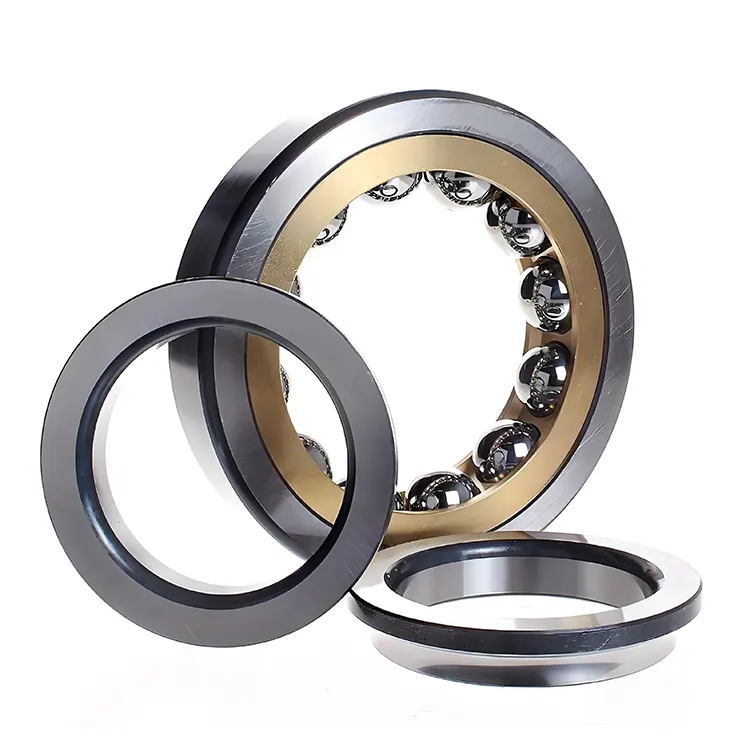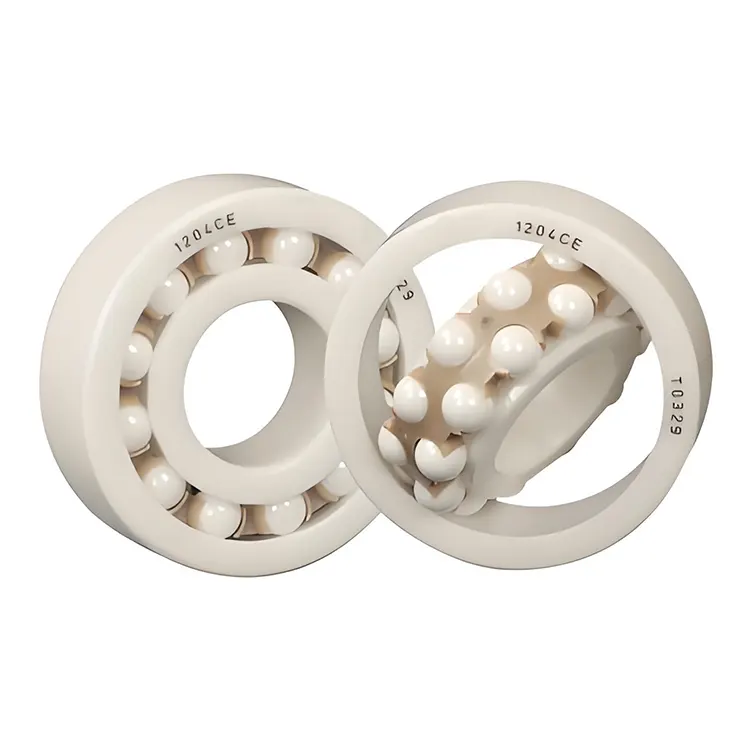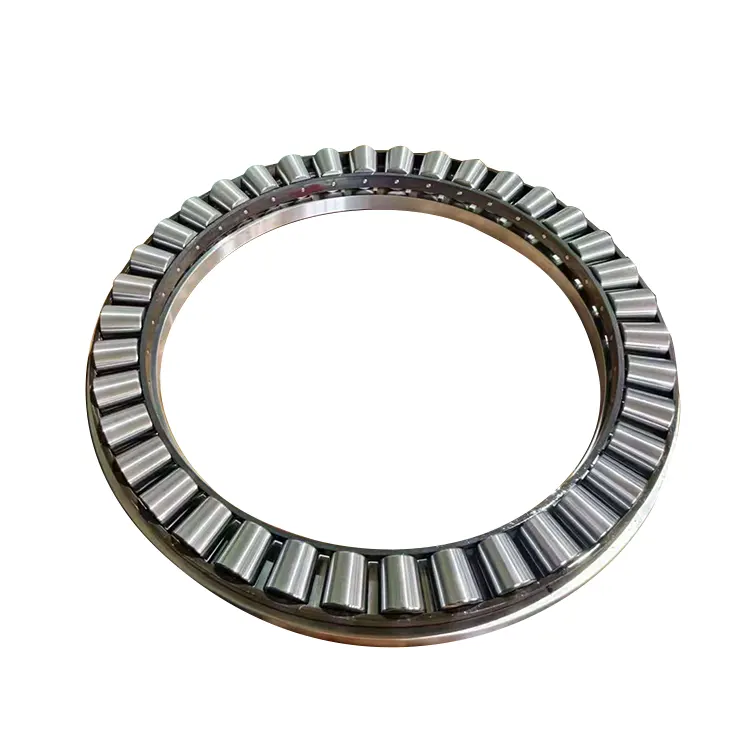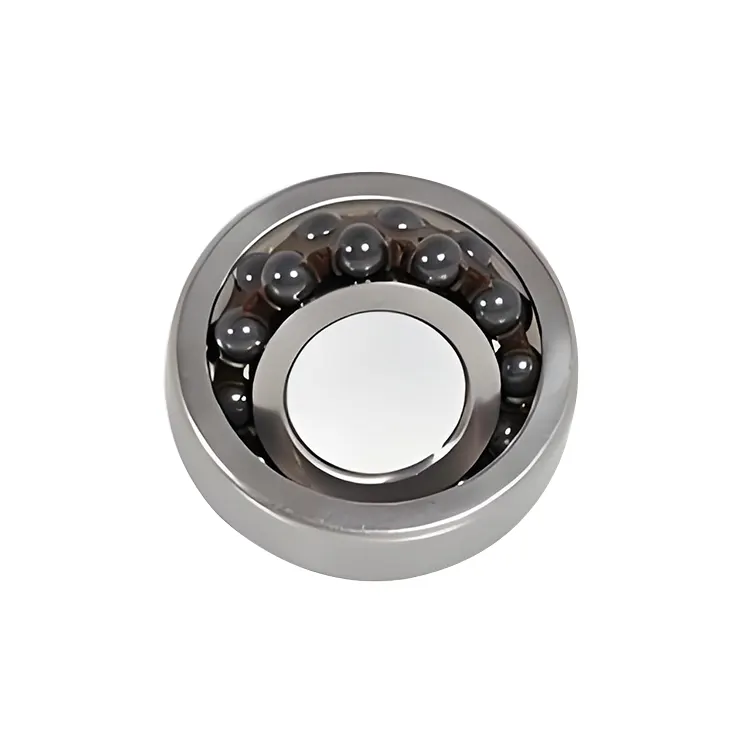

As a China-based thin section ball bearing manufacturer, KOMEL builds four-point contact rings for equipment where axial length and mass are fixed constraints. The 12,000-square-meter production base runs ISO9001 and ISO14001 systems, and the same cross-section is retained across bore variations so designers can step shaft diameter without redesigning the housing envelope.
The four-point contact geometry in a thin section ball bearing is not a marketing label; it describes a raceway that lets one ring set absorb radial loads, bidirectional axial loads, and overturning moments without stacking two angular contact bearings side by side. KOMEL, a bearing supplier working from a 12,000-square-meter facility, produces this family in inch-series KAA, KA, KB, KC, KD, KF, and KG ranges, with bore sizes spanning from 1.000 inch to 40.000 inch and section heights held constant within each series. The sections below describe how the internal geometry works, where the limits sit, and what to verify before placing a drawing on the table.
The inner and outer ring raceways are ground as pointed arch grooves, not as simple circular arcs. In a Four Point Contact Bearing for Overturning Moment Loads, the ball touches each ring at two points, producing four contact points across the assembly. This arrangement is what allows a single bearing to replace a back-to-back pair of angular contact bearings while consuming roughly half the axial width.
The contact angle is not fixed in the way it is in a standard angular contact bearing. Under pure radial load the ball sits near the bottom of the Gothic arch; under axial load it climbs the shoulder. This shift is useful, but it also means that preload and housing stiffness change the effective stiffness of the joint. For robot joints and optical stages where repeatable angular positioning matters, the mounting bore and shoulder squareness should be specified alongside the bearing tolerance class.
Within a given series, the radial thickness between bore and outside diameter does not grow as the bore increases. A KAA10XL0 with a 1.000-inch bore and a KAA17XL0 with a 1.750-inch bore share the same cross-sectional envelope; only the diameter changes. The table below shows the first three KAA sizes for direct comparison.
| Bearing number | Bore (in) | Outside diameter (in) | Land L1 (in) | Land L2 (in) | Weight (lbs) |
| KAA10XL0 | 1.000 | 1.375 | 1.140 | 1.235 | 0.026 |
| KAA15XL0 | 1.500 | 1.875 | 1.640 | 1.735 | 0.039 |
| KAA17XL0 | 1.750 | 2.125 | 1.890 | 1.985 | 0.045 |
The practical consequence is that a design team can change shaft diameter within a series without recutting the housing shoulder or changing the axial clamp length. It also means the weight penalty for a larger bore is modest: the KAA17XL0 weighs 0.045 lbs, roughly 1.7 times the KAA10XL0 at 0.026 lbs, while the bore grows by 75 percent. The fixed wall thickness does not change the moment capacity of a Four Point Contact Bearing for Overturning Moment Loads; it only changes ring diameter and mass.
A Four Point Contact Bearing for Overturning Moment Loads is chosen when the load path is mixed. The same ring set can carry a radial load from a belt pull, an axial load from a lead screw, and a moment from an offset center of gravity. In robot wrist and elbow joints, this reduces the joint from two bearing positions to one, which shortens the arm stack and lowers the moving mass.
The trade-off is that the contact points are not all equally loaded at once. Under a pure moment load, two diagonal contact points carry the load while the opposite pair unloads. The rings must be stiff enough to keep deflection within the clearance window, particularly when the bearing is preloaded. For medical imaging rotation, where the gantry turns slowly but positioning stability is critical, the moment stiffness rather than the dynamic capacity usually sets the bearing size.
Thin-section bearings are sensitive to out-of-round mounting bores because the ring wall is shallow. A housing bore that is within a general machining tolerance but oval by a few ten-thousandths of an inch can imprint that ovality onto the raceway and change torque and runout. For a Four Point Contact Bearing for Overturning Moment Loads, housing roundness at the bearing seat is therefore part of the selection, not a secondary detail. The fit tables for each series should be followed together with a check on housing roundness at the bearing seat.
KOMEL grinds these rings on CNC equipment and inspects finished dimensions against the drawing; the company’s quality system is certified to ISO9001 and ISO14001, and the production flow covers raw material selection through finished product inspection. For applications that require a specific running accuracy, the tolerance class and the inspection record should be stated on the purchase drawing rather than assumed from the series name.
| Series | Bore range shown (in) | Outside diameter range (in) | Weight range (lbs) |
| KAA | 1.000–1.750 | 1.375–2.125 | 0.026–0.045 |
| KA | 2.000–12.000 | 2.500–12.500 | 0.10–0.56 |
| KB | 2.000–20.000 | 2.625–20.625 | 0.16–1.50 |
| KC | 4.000–30.000 | 4.750–30.750 | 0.45–3.21 |
| KD | 4.000–30.000 | 5.000–31.000 | 0.78–5.73 |
| KF | 4.000–40.000 | 5.500–41.500 | 1.90–17.20 |
| KG | 4.000–40.000 | 6.000–42.000 | 3.60–30.80 |
Series KAA is the smallest cross-section in the set; KG is the thickest. Within each series the bore and outside diameter advance in steps, but the radial wall stays fixed. A 12.000-inch bore KA bearing and a 2.000-inch bore KA bearing share the same radial envelope, which is the defining characteristic of this Four Point Contact Bearing for Overturning Moment Loads family.
For a quotation that matches the application rather than a catalog number alone, the useful inputs are the bore and outside diameter required, the radial, axial, and moment load components, the mounting bore roundness, and the allowable axial clearance. KOMEL offers OEM and ODM support and can work from a drawing or a sample; the company’s export record includes North America, Germany, the United Kingdom, and Southeast Asia, and its engineering team reviews selection and custom requirements before production.
A: Yes, in many joint geometries. The four-point contact ring set carries radial, axial, and moment loads simultaneously, so a single bearing position can replace a back-to-back pair. The axial stack becomes shorter, but the housing bore must be stiff and round enough to support the shallow ring section.
A: The KA table lists sizes from a 2.000-inch bore (KA020XP0) to a 12.000-inch bore (KA120XP0), with outside diameters from 2.500 to 12.500 inches. Intermediate sizes in the series follow the same step pattern.
A: Within one series, yes. The radial wall does not change as the bore increases. A KA020XP0 and a KA120XP0 share the same section height; the ring diameters scale, but the radial thickness stays constant.
A: The axial clearance or preload should be matched to the mounting stiffness and the load direction. For a robot joint, the moment stiffness and the repeatable positioning requirement usually set the target; for a medical imaging rotation, smooth torque at low speed may take priority. The bearing drawing should state the clearance or preload range rather than leave it to a series default.