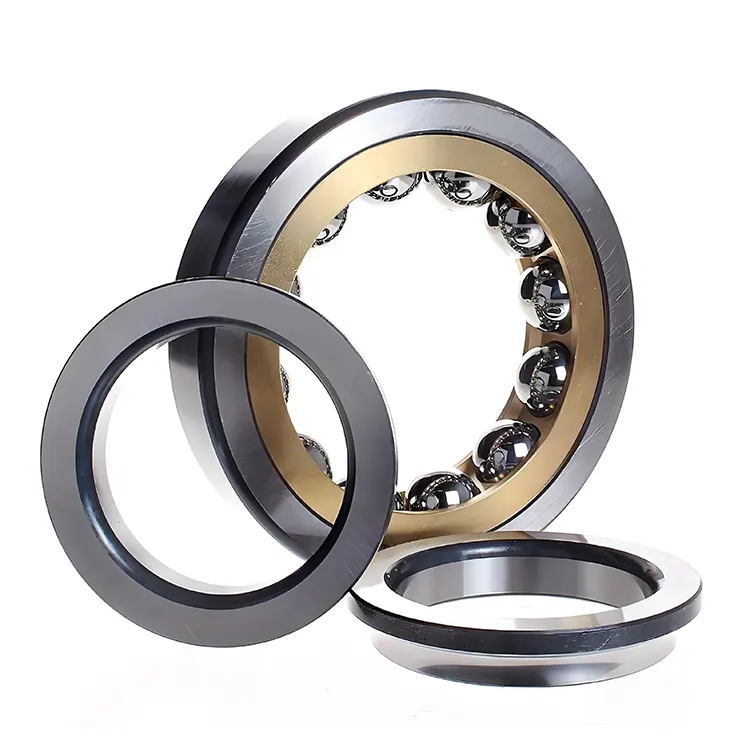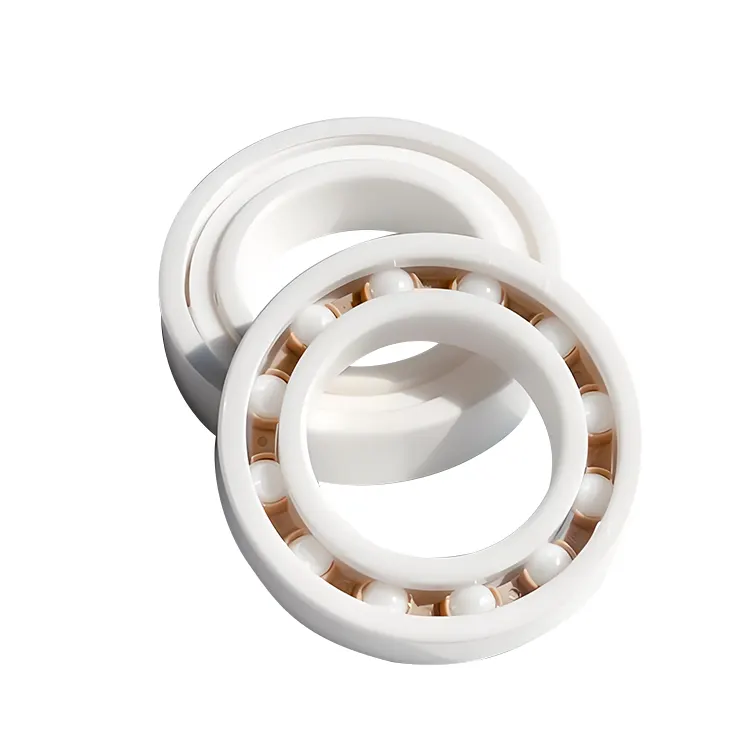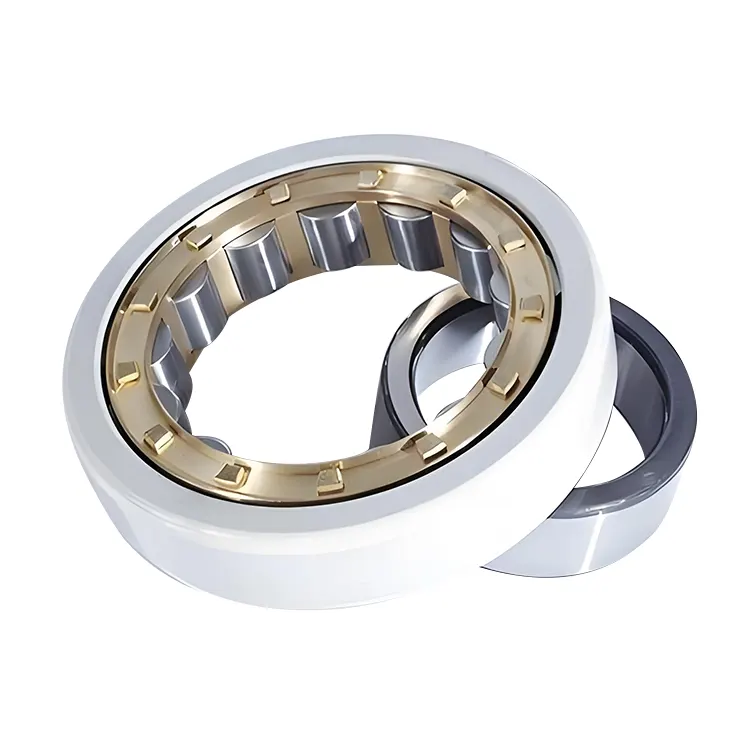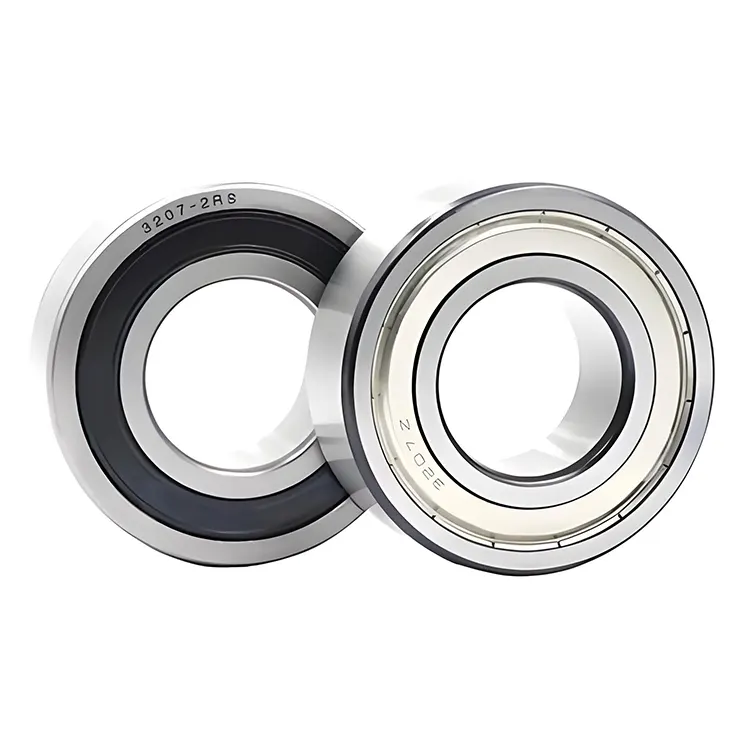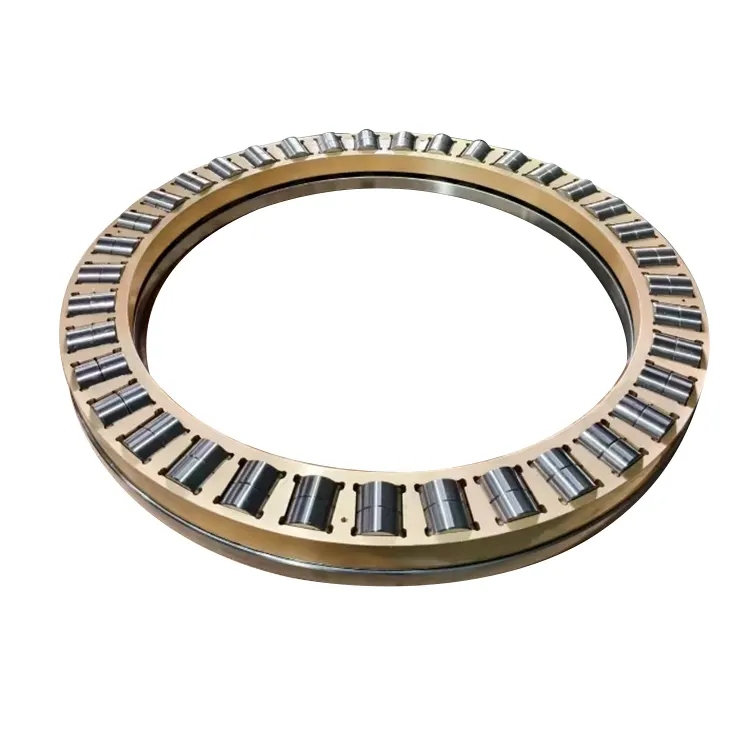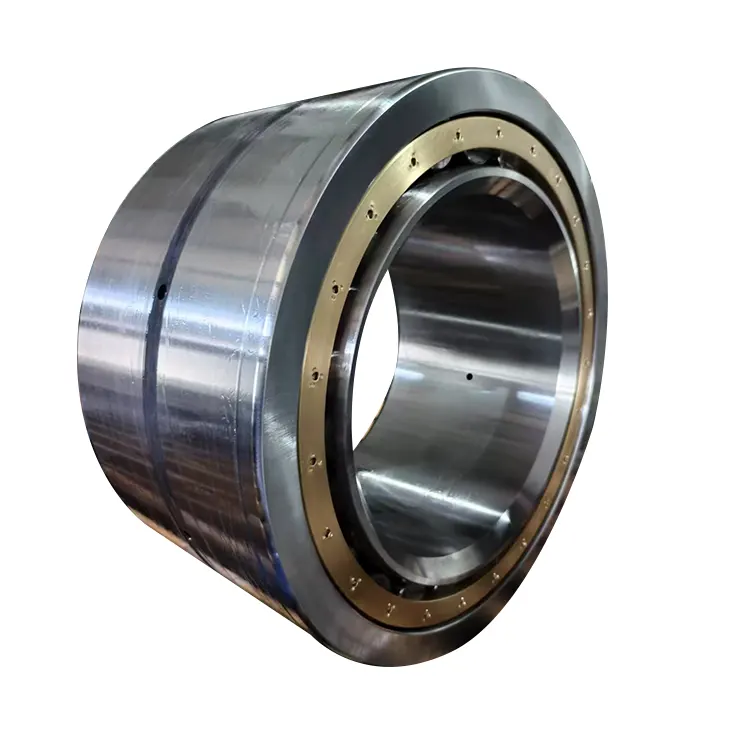

Four Point Contact Bearing for Optical Instrument Positioning from Komel Bearing Co., Ltd., a China manufacturer, brings thin-section geometry to optical alignment work. Pointed arch grooves create four contact points between ball and rings, so one unit handles radial, bidirectional axial and moment loads at a width close to a single angular contact bearing. Production runs to ISO9001 at a 12,000 sqm facility, and standard models are stocked for early bench verification.
In a gimbal, a lens focusing mechanism or a rotation stage, fewer parts mean a shorter path for assembly stack-up and thermal drift. A single raceway set constrains radial runout, bidirectional axial play and overturning tendency at once, compressing the function of two angular contact bearings into roughly one width. The Four Point Contact Bearing for Optical Instrument Positioning is chosen here not for peak load figures but for how many constraint directions one compact node can carry, which is what optical adjustment really needs.
A standard angular contact pair normally needs two bearings mounted back to back or face to face, using about twice the axial width. One thin-section unit delivers comparable radial, bidirectional axial and moment constraint with smaller width.
1. Narrower stack: roughly one bearing width instead of two.
2. Fewer interfaces: less stack-up error and fewer preload steps.
3. Simpler assembly: no pairing orientation to control on the line.
Four-point contact is not only about carrying loads in more directions. Under preload, the four contact points form a symmetric stiffness distribution, so response to moment load over a small angular range behaves closer to continuous rather than jumping across clearance. That is what an optical adjustment feels in use: settling at target instead of hunting around it. The Four Point Contact Bearing for Optical Instrument Positioning also keeps that response stable when load direction shifts during adjustment.
The thin section brings low inertia, which helps a mechanism driven by a stepper or servo converge on target angle quickly with less overshoot and oscillation.
1. Faster settle: short overshoot and quick damping at target angle.
2. Less drive load: smaller mass to accelerate and brake.
3. Stable micro-motion: smoother response at small angular steps.
P5, P4 and P2 accuracy grades are supported, with the available grade confirmed by bore and structure. Stating the target angular repeatability at selection keeps inspection and packaging conditions aligned with the actual optical requirement.
The range covers KAA, KA, KB, KC, KD, KF and KG thin-section series, with bores from small imperial sizes up to several tens of inches. The table gives selected KAA series models in inches and pounds for first-pass selection. In every series section thickness stays fixed, so the Four Point Contact Bearing for Optical Instrument Positioning scales by bore rather than by section.
| Model | Bore (in) | Outside Diameter (in) | Land L1 (in) | Land L2 (in) | Weight (Pounds) |
| KAA10XL0 | 1.000 | 1.375 | 1.140 | 1.235 | 0.026 |
| KAA15XL0 | 1.500 | 1.875 | 1.640 | 1.735 | 0.039 |
| KAA17XL0 | 1.750 | 2.125 | 1.890 | 1.985 | 0.045 |
Optical positioning often starts small and light. As clear aperture or barrel size grows, the next bore in the same series can be selected while section thickness stays the same.
1. Same section: bore grows, section thickness does not.
2. Reusable seat: mounting and axial features stay valid.
3. Faster variants: new platform sizes reuse the existing design.
In telescopes and microscopes, moving elements must travel along the optical axis or deflect through a limited angle smoothly. The small section and low friction of the thin-section design make even micro-motion easier to control, whether the drive is manual or motorized.
Rotating components in laser measurement equipment are sensitive to angular repeatability. The symmetric constraint of four-point contact helps reduce the difference in response when load direction changes, which is the practical source of hysteresis in a positioning node.
Azimuth and elevation axes in gimbals frequently use this bearing type to achieve multi-directional constraint within one compact node.
1. Short axis stack: azimuth and elevation nodes stay compact.
2. Lower part count: fewer components per axis assembly.
3. Steadier adjustment: symmetric constraint reduces direction-dependent drift.
Komel has more than ten years of bearing research and manufacturing experience. Its 12,000 sqm base holds high precision CNC grinding machines, lathes, and heat treatment and inspection equipment, with ISO9001 and ISO14001 certification covering quality and environmental management. Products have been exported to the United States, Canada, Germany, the UK, South America, the Middle East and Southeast Asia.
Standard thin-section models are held in stock for early verification, and custom manufacturing is available when raceway parameters or materials differ from the catalogue.
1. Sample stage: confirm dimensions and rotation accuracy against the optical requirement.
2. Custom stage: define raceway geometry, clearance, material and surface treatment.
3. Volume stage: keep the same inspection basis as the approved sample.
A: A paired angular contact arrangement needs two bearings and about twice the axial width. One thin-section unit gives similar radial, bidirectional axial and moment constraint in less width, with fewer parts and fewer mating faces, which supports compact nodes and steadier repeatability.
A: The design has more contact points than a two-point deep groove bearing, but thin-section series are built around low friction in raceway geometry and ball matching. Actual friction torque also depends on preload, lubrication and speed, so check parameters against micro-motion frequency and drive capability rather than contact count alone.
A: When an instrument moves to a different clear aperture, the bore can change while section thickness and the bearing seat stay the same. Barrel, bracket and drive module layouts do not need redesign just because the size changed.
A: Standard thin-section models are kept in stock and custom manufacturing is supported. For bench verification, state mounting tolerance, preload method and target angular repeatability so the test reflects real service conditions.
A: P5, P4 and P2 grades are available with the feasible grade set by bore and structure. Stating the repeatability target first and then matching the grade is more practical than selecting the highest grade by default.